06
Technical Writing
34 essays, mostly interactive, organized as five short series — read any one alone, or follow a series
top to bottom. Earlier long-form work lives on Medium.
Why long tasks fail and the machinery that fixes it — pacing, memory, forgetting, rollback, and the loop itself.
 Agents
Your AI Agent Is a Marathoner, Not a Sprinter
Long-horizon agents fail like marathoners, not sprinters — a playbook on compounding error, context rot, pacing, checkpoints, context resets, and sub-agent relays, backed by a 20,000-trial simulation.
 Agent Infra · Interactive
Agents Can Sprint. Memory Lets Them Run Marathons. · New & interactive
The sequel to the marathon post: the baton itself. Models sustain 30+ hour tasks but every context window still gets wiped — why agent memory and its deployment is the whole ballgame, via Anthropic’s long-running harness and Nous Research’s self-correcting Hermes — with a live "memory relay" simulation you can steer (failure rate, context size) and the design-review checklist.
 Agent Memory · Interactive
Your Agent Has a Filing Cabinet. It Needs a Hippocampus. · New & interactive
Agents get one flat memory store; cognition runs four — working, episodic, semantic, procedural — wired by consolidation during sleep. The architecture mapped to agent infra (MemGPT, Generative Agents, Voyager assembled into one design), retrieval as ranking, forgetting as precision — and a live consolidation lab: 14 simulated days where the agent that sleeps ends ~50 points ahead of the one that hoards.
 Agent Infra · Interactive
The 30-Hour Agent Is an Infrastructure Problem. · New & interactive
The loop as an operating system: context as RAM (compaction high-water marks, KV-cache discipline, spill-to-disk), tokens as the meter (hierarchical budgets, circuit breakers), watchdogs + Erlang-style supervision, and an eval pyramid for runs too long to rerun — with a live run console where toggling compaction, watchdog, or checkpoints decides whether a simulated 30-hour run survives.
 Agent Reliability · Interactive
Long Tasks Don’t Fail. They Compound. · New & interactive
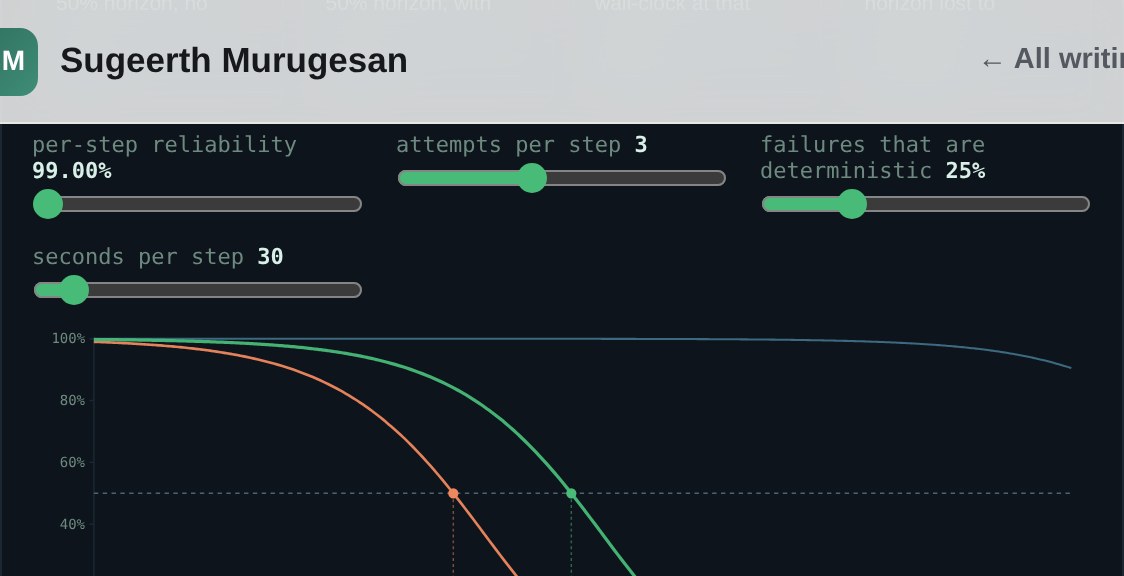
A 99%-reliable agent is a coin flip after 69 steps. Task success is per-step reliability raised to a power, and the horizon is one number: ln(0.5)/ln(p). The 10× rule, why retries buy 2,500× less than the math promises once failures correlate, and a live horizon calculator that turns your step reliability into the longest task you can actually finish.
 Context Management · Interactive
The Plan Is the First Thing You Forget. · New & interactive
Long-horizon agents don’t run out of context — they run out repeatedly and compress their way out, and compression takes the oldest thing first: the plan. Why compaction fidelity compounds (each doubling of task length squares the loss), why 90% fidelity retains just 43% over 800 steps, and a live lab running five context policies against one identical task.
 Agent Operations · Interactive
You Don’t Deploy an Agent. You Operate a Fleet. · New & interactive
Every ops primitive you own — p99 latency, retries, canaries, circuit breakers — assumes work that takes milliseconds. Runs take hours. A live fleet view of 32 concurrent agents across one shift, a toggle that shows you exactly what your dashboard cannot see (78% reported, 50% real), and the five panels to build this week.
 Post-Training × Memory · Interactive
Memory Is Post-Training With a Learning Rate of 1.0 · New & interactive
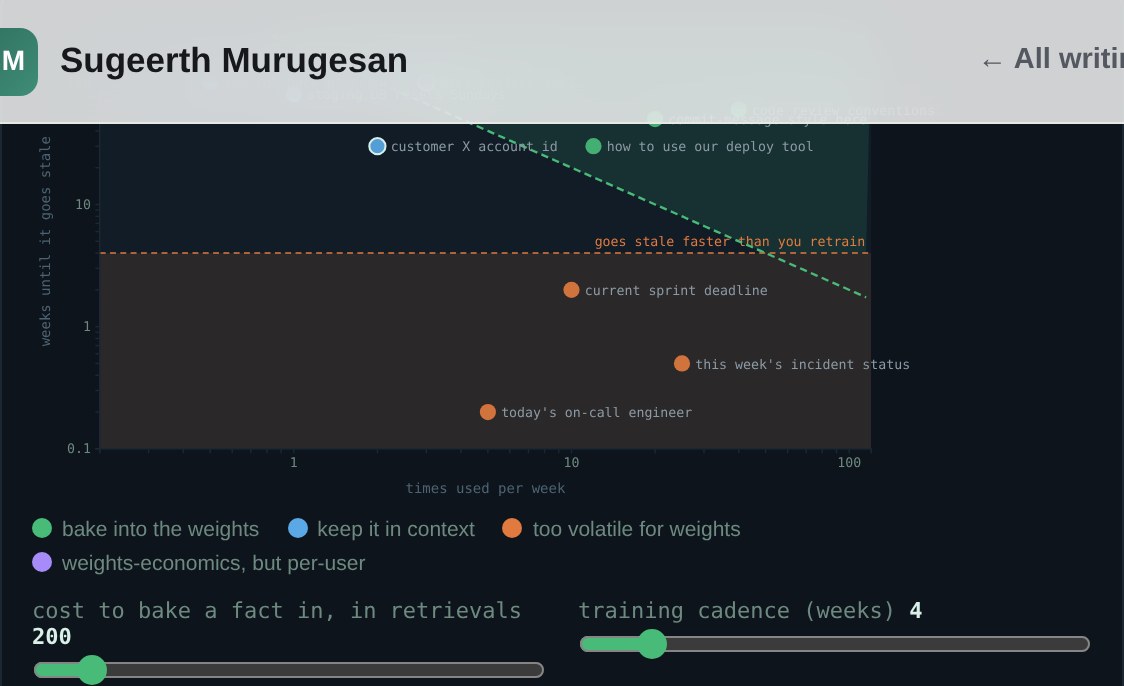
A memory write and a gradient step are the same operation at opposite ends of a learning-rate continuum. A derivable boundary for whether a fact belongs in context or in weights (u×h>B, drawn as a phase diagram), why catastrophic forgetting and context compaction are the same bug, and the lab showing why self-training on your agent’s own successes gets more dangerous the better your model gets.
 Agent Memory × Systems · Interactive
Your Context Window Is a Cache. Start Measuring It Like One. · New & interactive
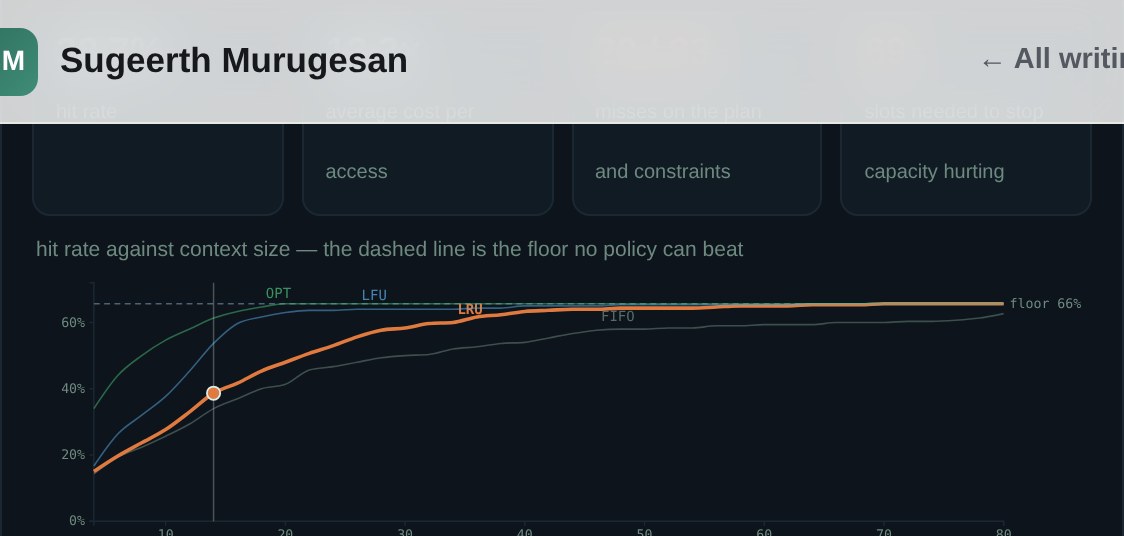
Agent memory is a caching problem, and caching has sixty years of measurement behind it. AMAT, the three kinds of miss, and Belady’s optimal as an oracle you can actually compute from a logged run. Agent traces have inverted locality — the plan is the most needed and least recent thing — so LRU needs 69 slots to do what perfect eviction does in 20.
Evaluation and trust — from grading traces to catching gamed metrics to deciding when an agent may act alone.
 Post-Training · RL · Interactive
Most of Your Rollouts Change Nothing. The Environment Decides How Many. · New · interactive
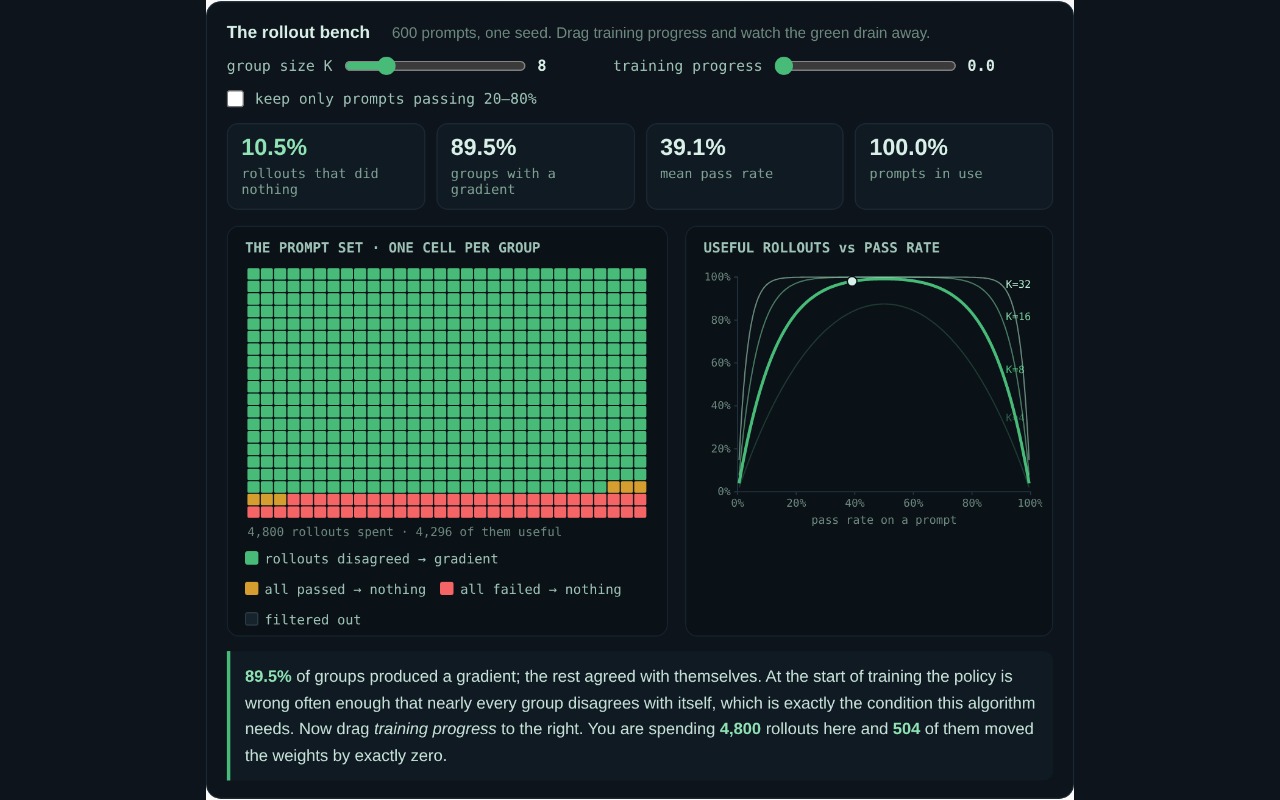
In GRPO a unanimous group has an advantage of exactly zero and still costs K rollouts. At a 99% pass rate that is 92.3% of your compute buying nothing — and the formula is symmetric, so too-hard and too-easy are the same failure. Shows environments decaying as the policy improves (89.5% useful groups down to 58.5% on a fixed prompt set) and prices the three ways out.
 Agent Evaluation · Interactive · D3
Six Agents Finish the Same Task. The Trace Knows Who’s Better. · New & interactive
Six differently-scaffolded agents, one task, same harness — an answer-only judge calls it a six-way tie while the traces blow them apart. A trace-metric framework (recall@K, progress-AUC, loop rate, verification, pass^k), behavioral clustering with kNN drift alarms, and a live D3 fingerprint lab that runs the whole experiment in your browser.
 Evaluation
You’re Grading Your AI on the Wrong Test · New
A benchmark win isn’t a model that works — a playbook on eval variance, contamination, biased LLM judges, and reliability@k, backed by a 20,000-trial simulation of how grading method beats raw model quality.
 Self-Improving Systems · Essay
Catching Goodhart in the Act · New & interactive
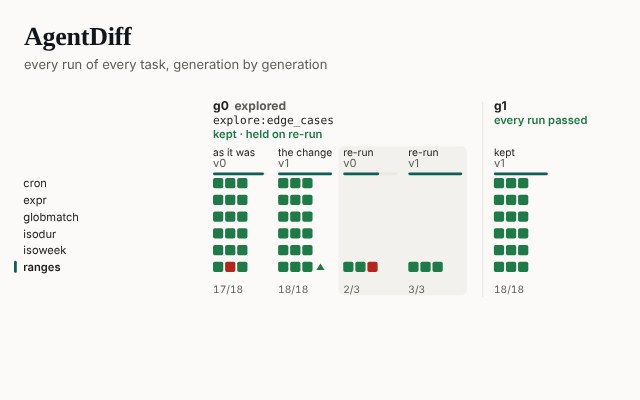
I let a model improve itself against its own grader and watched the score climb while held-out truth quietly fell. Divergence-onset monitoring caught the gaming within 2–11 generations in 100% of gamed runs — with a live simulation and the "verifier half-life" playbook.
 Agentic AI · Report
Fifteen Domains, One Wall: The Verification Gap · New
Read agentic AI across fifteen domains at once and the same wall appears in every one. Why the bottleneck was never generation — it’s verification — and where value migrates next: the “Trust Stack.”
 Agent Autonomy · Interactive · D3
Autonomy Is a Dial, Not a Switch. · New & interactive
When should an agent ask, tell, or just act? An expected-loss framework (confidence × stakes × reversibility), a per-task-class trust ratchet, escalation mechanics that prevent rubber-stamping — and a live policy observatory: 400 streaming decisions, draggable thresholds, and a Pareto frontier showing exactly where your policy sits between interruptions and catastrophes.
 Post-Training Evaluation · Interactive
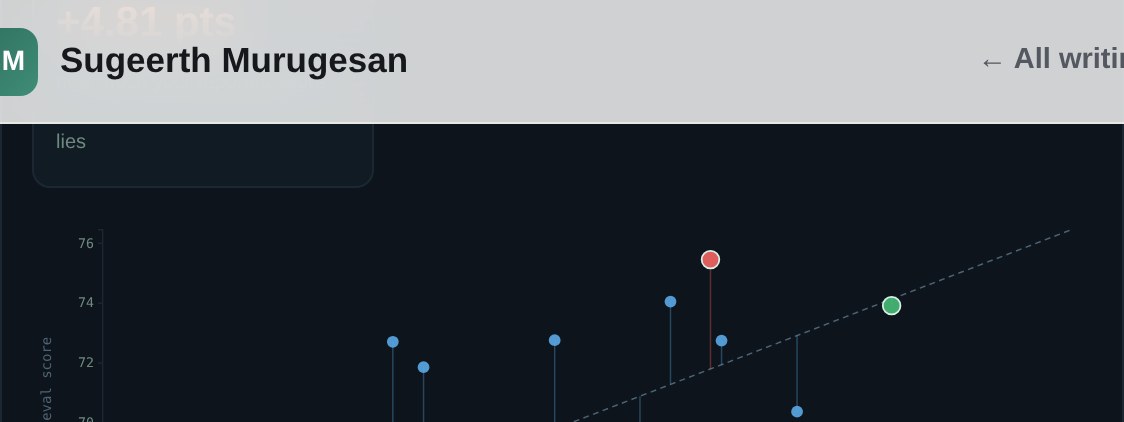
You Didn’t Pick the Best Checkpoint. You Picked the Luckiest One. · New & interactive
A 200-item eval measures to ±3.2 points; checkpoints differ by one. Taking the max of noisy scores is selection, not measurement — in the live lab, best-of-twelve finds the genuinely best checkpoint 23% of the time and reports a score 4.8 points hot. Plus the pairing trick that buys a 4× power gain for zero extra compute.
The surfaces agents touch and produce — tool contracts, visualization as infrastructure, and answers that render.
 Agent Infra · Interactive
Your Agent Isn’t Dumb. Its Tools Are. · New & interactive
Most “agent failures” are interface failures: a tool definition is a prompt the agent re-reads at every decision point. The seven sins of tool design (ambiguous names, kitchen-sink params, unbounded responses, dead-end errors…), a per-tool eval loop — and a live grader that scores any MCP / function-calling JSON on 8 dimensions as you type.
 Visualization × Agents · Interactive
Agents Became Systems. Nobody Drew Them. · New & interactive
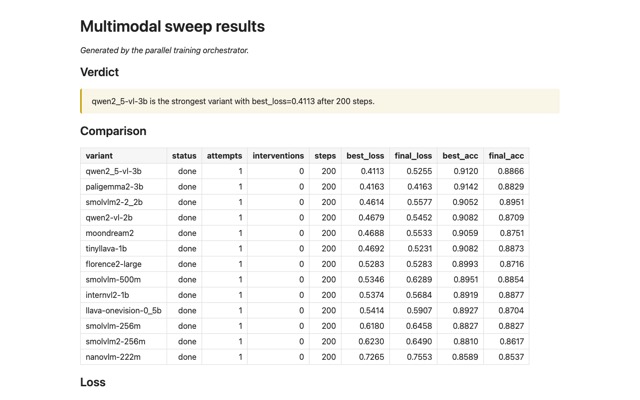
We debug distributed systems by scrolling JSONL. A five-layer framework for visualization across the agent lifecycle — trace waterfalls, behavior fingerprints, workflow flows, live architecture maps, deployment dashboards — grounded in Shneiderman / Tufte / Munzner, with a live D3 control room: plug the Planner, Memory, and Verifier in and out of a running agent system and watch the consequences flow.
 Generative UI · Live Demo
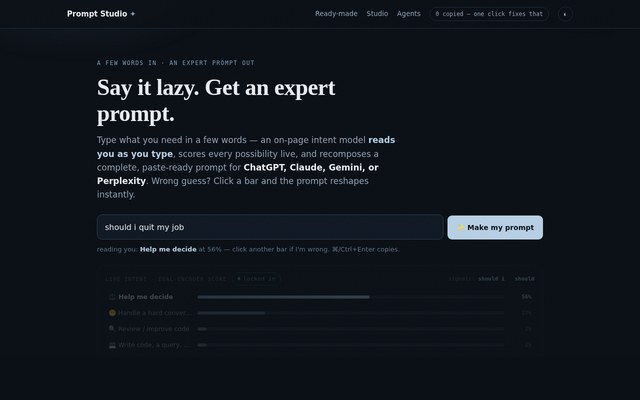
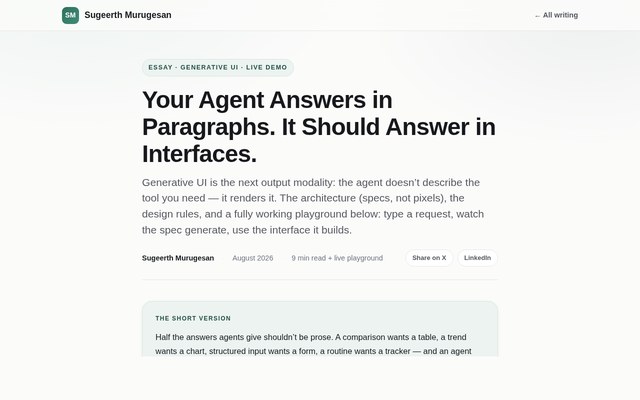
Your Agent Answers in Paragraphs. It Should Answer in Interfaces. · New & live demo
Generative UI: agents that render the tool you needed instead of describing it. The specs-not-pixels architecture, UI components as tools, evals for interfaces — and a fully working playground in the post: type a request, watch intent → spec → validate → render light up, then use the generated charts, forms, trackers and timers. Edit the spec JSON, watch the UI rebuild.
 Field Report · Interactive
The Last Click · New & live trace
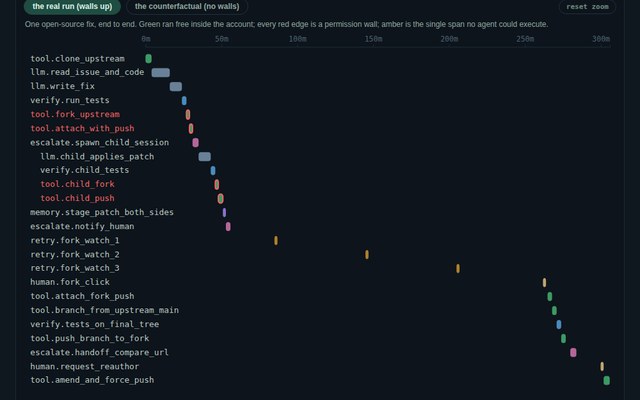
An agent fixed a real open-source bug in forty minutes. Shipping it took five hours, two agent sessions, four permission walls — and exactly one human click. The complete trace of a real contribution, rendered as a live span waterfall next to its no-walls counterfactual, and the design lessons: prepared artifacts, legible denials, consent as the interface.
 Voice Agents · Interactive
The Model Talks. Code Decides. · New & interactive
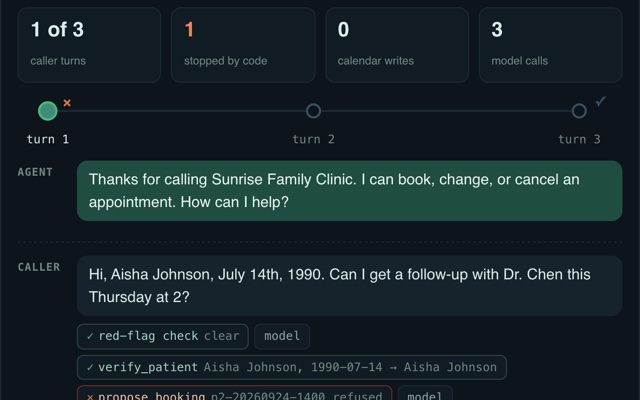
A phone scheduling agent for an invented family clinic. The model runs the conversation; four checks in code decide what reaches the calendar: who is calling, only times the calendar returned, a clear yes on a later turn, and asking when two patients fit. Replay five calls, including twins who share a birthday.
Where the durable value sits — the harness over the model, domain depth over generality, and the real cost of more agents.
 Agent Strategy · Interactive
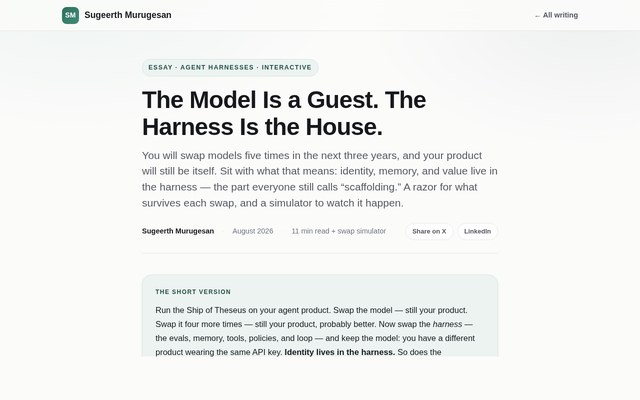
The Model Is a Guest. The Harness Is the House. · New & interactive
You’ll swap models five times and your product will still be itself — identity lives in the harness. A razor for what survives each swap (model-shape depreciates, world-shape compounds), the rehearsed swap protocol, the bitter-lesson counterargument taken seriously — and a live simulator: 36 months, six model generations, the moment the system detaches from its own model.
 Agent Strategy · Interactive
The Next Million-Dollar Agent Is Boring and Domain-Specific. · New & interactive
General agents demo; domain agents invoice. The full playbook: collect & curate expert data into one corpus that compiles to three artifacts, climb the training ladder (scaffold → SFT → DPO → distill), answer by K verified paths with a judge, gate everything on a golden eval set, deploy on a trust ratchet — with a live multipath explorer showing what each extra path buys.
 Multi-Agent · Report
More Agents Isn’t Better: The Coordination Tax · New
Two frontier labs reached opposite conclusions on multi-agent systems. The reconciliation — single strong agent by default; multi-agent only for verifiable, parallel breadth — plus the ~15× token tax and the MAST failure taxonomy.
The modeling layer underneath — retrieval systems and explaining what the ranker did.
 Serving · Deep Dive · Interactive
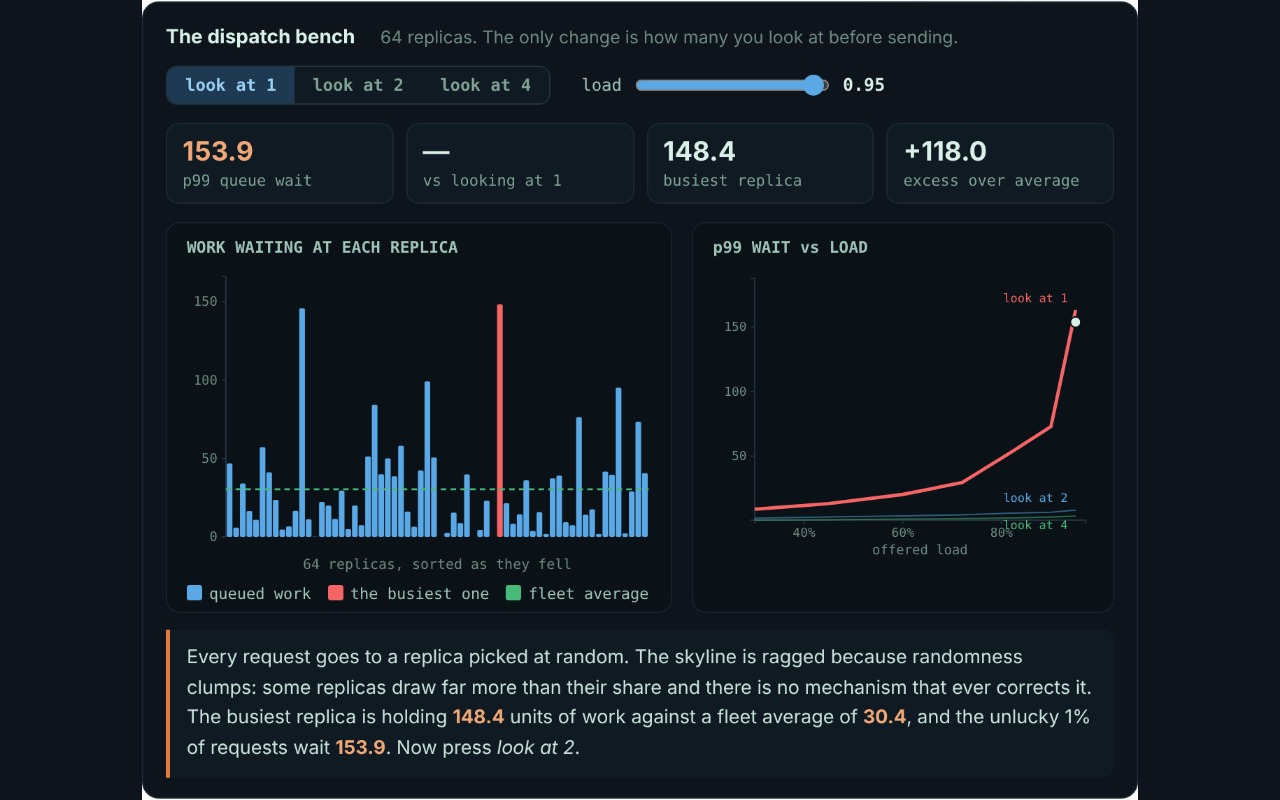
Ask Two Servers, Not One. The Tail Collapses. · New · interactive
Dispatch each request to a random replica and the busiest one runs 112 requests ahead of average, growing without bound as traffic rises. Probe two and take the shorter queue: the excess pins at 1.9, flat across three orders of magnitude. Worth 18× at p99 under load — and the second extra probe buys only 2.3× more, which is why you stop at two.
 Retrieval · Deep Dive · Interactive
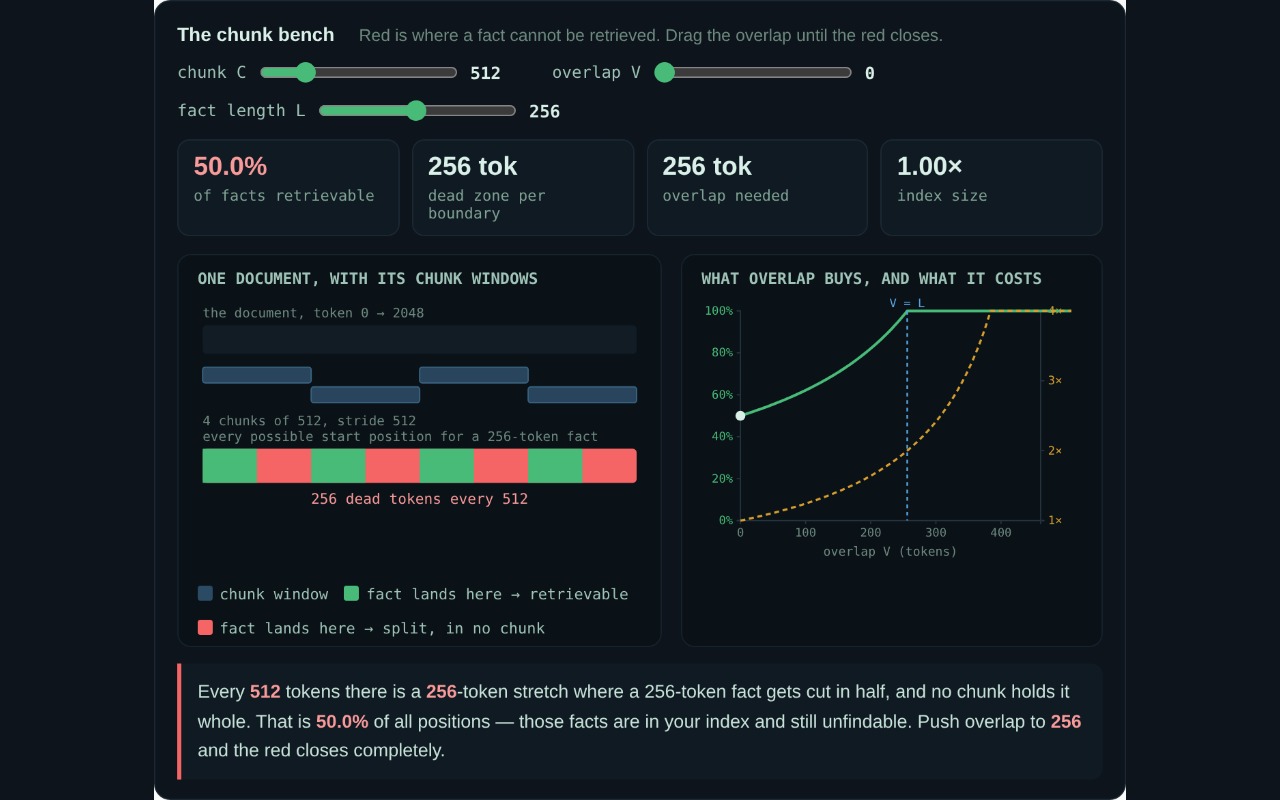
Your Chunker Is Deleting Facts. The Overlap You Need Is Exact. · New · interactive
A 256-token fact in 512-token chunks with no overlap is retrievable exactly half the time — not ranked badly, absent. Derives the one-line formula, shows the overlap you need is your longest fact and not a percentage, prices the guarantee, and explains why your retrieval eval structurally cannot see the failure. Live chunker you can drag.
 Retrieval · Deep Dive · Interactive
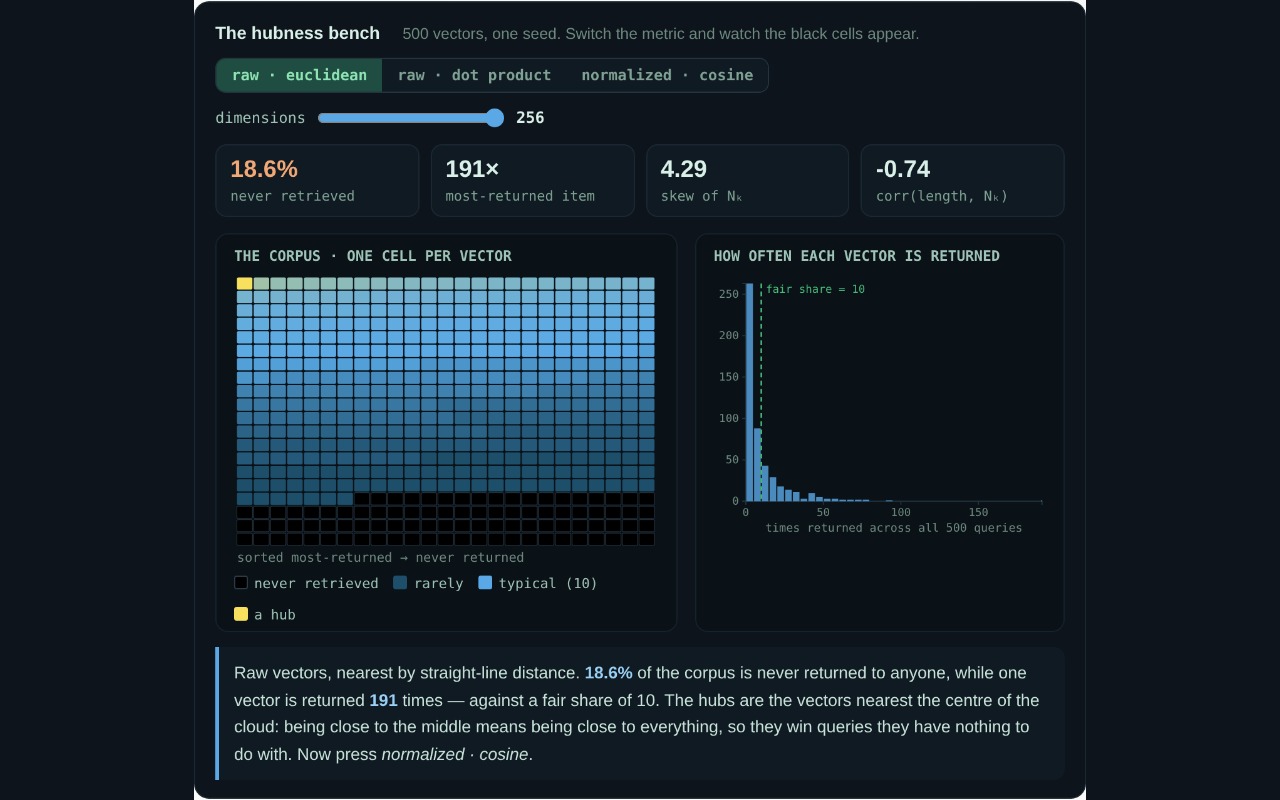
A Fifth of Your Corpus Is Unreachable. It Isn’t the Dimensions. · New · interactive
Drop the L2 normalization and 18.6% of a 500-vector corpus is never returned to any query, while one vector takes 191 of 5,000 result slots. Normalize and it is 0.0% at every dimension. The usual explanation — the curse of dimensionality — turns out not to fit the measurement: the villain is a length gradient, and the lab rebuilds the whole index in your browser so you can check.
 Inference · Deep Dive · Two Labs
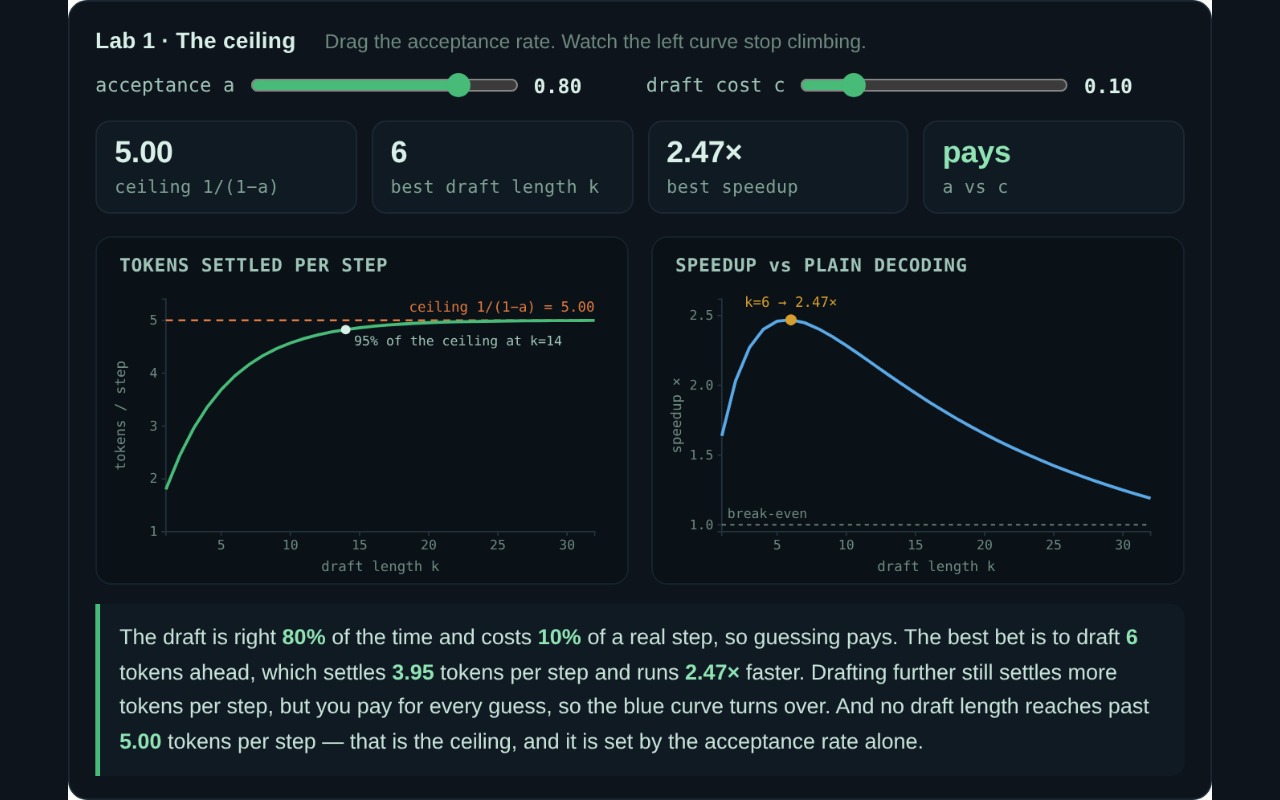
Your Model Guesses Ahead. The Ceiling Is Exact. · New · interactive
Speculative decoding has a closed form, and a hard edge nobody puts on the slide: a step settles at most 1/(1−a) tokens, so an acceptance rate of 0.8 caps you at 5× with a free drafter and an infinite draft. Derives the ceiling, proves guessing pays iff a > c, and shows the part benchmarks hide — the median gets faster while the p99 runs 67% past it on the short bursts agents actually emit.
 ML System Design · RecSys · Interactive
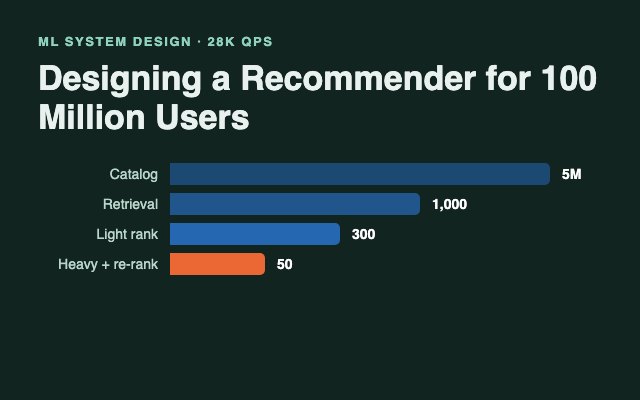
Designing a Recommender for 100 Million Users · New & interactive
The full ML system design interview, worked end to end: a video home feed at 28K QPS. Objective and labels, a live capacity calculator, the three-time-scale architecture, two-tower retrieval, multi-task ranking, re-ranking, cold start, training and serving at scale, evaluation, and the follow-ups that separate senior from staff answers.
 Systems · Two Interactive Labs
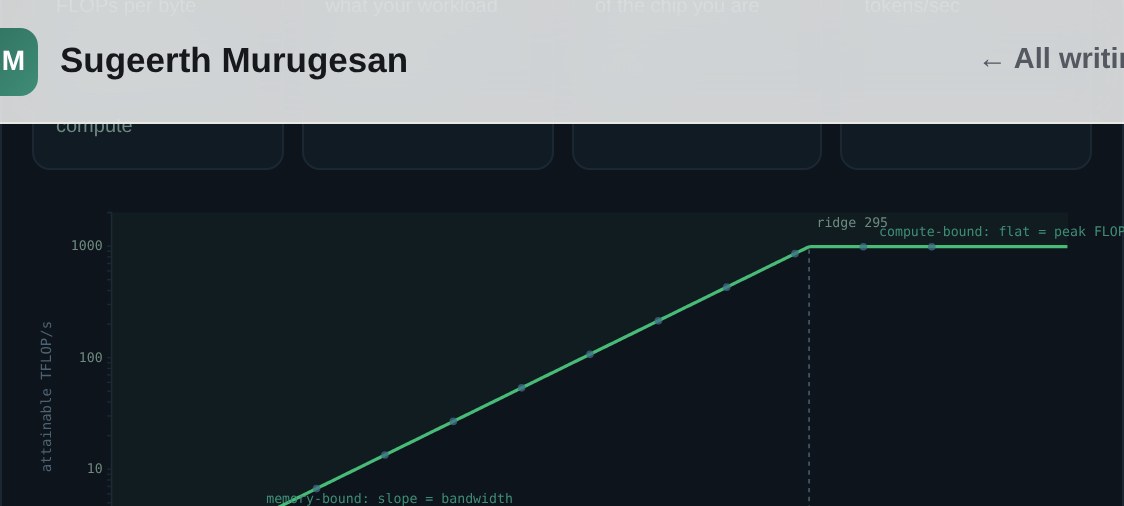
Your GPU Is Not Computing. It Is Waiting. · New & interactive
Generating one token from a 70B model on an H100 uses 0.34% of the chip. The memory wall derived from first principles — roofline and arithmetic intensity, the KV-cache capacity wall, FlashAttention’s online softmax and I/O complexity, and every optimization (batching, quantization, speculation, GQA, paging, tensor parallelism) as one move on one chart. Two live labs.
 Explainability
Why Did You Rank That? Explainability for LLM-Powered Retrieve-and-Rank · New
A method-by-method field guide to explaining the four-stage ranking funnel — SPLADE/ColBERT structural readouts, RankingSHAP, activation patching, faithful logit signals, counterfactual stage ablation — and the one rule underneath them all: plausible is not faithful. Fact-checked multi-agent research pass.
Designing deep learning models is hypothesis-driven; interpretability is key to trustworthy models — the Achilles' heel of deep neural networks.
An attempt to clearly explain the simplest ML algorithm in Python — predicting a linear relationship between inputs X and an output Y.
Neural networks are now ubiquitous — convolutional, recurrent and beyond — with manifold applications across medicine, transportation, and visualization.
The importance of visual analytics in machine learning, as ML methods play an increasingly influential role in the world.
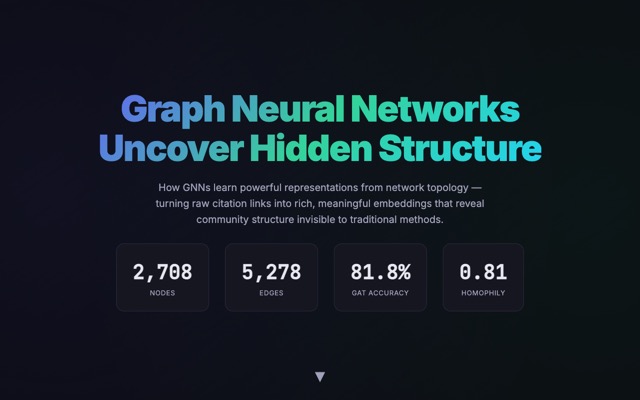
Transportation, brain, and social networks all rely on machinery from graph theory and data visualization.