A person who remembered everything — every plate they ate, every license plate they passed — wouldn’t be a genius. They’d be paralyzed. Human memory is powerful because it is aggressively lossy: it consolidates the useful, discards the rest, and keeps the working set small. We built agent memory the exact opposite way — an infinite, undeleting append log — and then act surprised when the agent can’t find the one thing that mattered.
“Give the agent a memory” has quietly become “dump every turn into a vector store and retrieve the top-k.” That’s not a memory. It’s a filing cabinet with no one filing. And the longer the agent lives, the more it fails — not because the model got worse, but because the haystack grew around the needle.
01Three ways the “memory” betrays you
Almost every agent-memory failure is one of these three. Each has a fix borrowed from how brains — and databases — have always handled this.
1. Hoarding buries the signal (context dilution)
Retrieval is noisy. Ask for the top-8 most relevant memories and you’re really asking “which 8 score highest on a fuzzy similarity metric?” With 30 stored items, the fact you need usually wins. With 3,000, it gets out-ranked by near-duplicates and coincidental matches. The store grew; the budget didn’t. Every irrelevant memory you keep is a distractor competing to be retrieved.
› Go deeper: why “just retrieve more” backfires
The reflex is to widen the budget — retrieve top-50 instead of top-8. But a model’s ability to use what’s in its context degrades as that context fills with marginally-relevant filler: the “lost in the middle” effect, where information buried in a long context is effectively ignored. So widening retrieval trades a miss for a dilution. You don’t want more recall surface — you want a smaller, cleaner store, so the top-8 is actually the right 8.
2. Naive forgetting throws away what you still need
So you cap the store — keep only the last N items, FIFO. Dilution solved. But now the agent forgets the user’s name because it was mentioned 200 turns ago, while faithfully remembering the weather from five minutes ago. Recency is not relevance. A sliding window forgets by age, when it should forget by value.
› Go deeper: the two ways to be wrong
There are exactly two failure modes, and they pull in opposite directions. Keep too much and you drown in distractors (the hoarder). Drop the wrong things and you lose durable facts (the FIFO window). A good policy has to be selective in a way that pure size limits never are: it needs a notion of which memories are worth keeping — importance, not just timestamp.
3. No consolidation means infinite duplicates
An agent told the same fact five times stores it five times. It learns a preference, then its opposite, and keeps both with equal weight — no reconciliation, no overwrite, no “this supersedes that.” Brains consolidate: they merge repeated experience into a single stronger trace and resolve contradictions. A pile of raw transcript turns does none of that.
› Go deeper: memory is a write problem, not a read problem
We pour all the engineering into the read path — better embeddings, rerankers, hybrid search. But the leverage is on the write path: deciding what is even worth storing, merging duplicates on the way in, marking facts as superseded, and decaying importance over time. Get the write path right and the read path gets easy, because there’s simply less junk to retrieve through.
02Borrow the rules brains and databases already wrote
The reassuring part: forgetting-on-purpose is a solved design problem in two different fields. Cognitive science has studied memory consolidation for a century; systems engineering has run bounded caches for fifty years. Almost every rule maps cleanly onto agent memory.
| Principle (brain / DB) | Why it works | The agent-memory move | What it prevents |
|---|---|---|---|
| Forget by value, not age | Importance, not recency, predicts what you’ll need again | Score each memory’s importance; evict the lowest, not the oldest | Losing durable facts to a FIFO window |
| Consolidate on write | Merge repeated experience into one stronger trace | Dedupe & summarize at ingestion; one canonical fact, not five copies | Duplicate distractors crowding retrieval |
| Supersede, don’t append | New truth should overwrite old, not coexist with it | Detect contradictions; mark facts stale/superseded | Retrieving a belief and its opposite |
| Decay unused traces | What you never recall, you probably don’t need | Apply time + usage decay; let cold memories fade | An ever-growing, ever-noisier store |
| Bound the working set (LRU/LFU) | A cache earns its speed by staying small | Cap the hot store; page cold facts to cheap cold storage | Context dilution from unbounded growth |
| Tier your memory | Registers, RAM, disk — not everything lives hot | Split working / episodic / semantic memory with different retention | Treating a chat log as a knowledge base |
03I simulated it — and you can run it live
To separate the memory policy from the model quality, I built a small Monte-Carlo simulation. One agent, three memory policies, the exact same retrieval engine underneath. Each session adds a few new items — some are durable facts you might be asked about later, the rest are ephemeral noise. Then we query a fact and ask: did the right memory make it into the top-8 the agent actually reads?
- Append-all — keep everything forever. The fact is always in there — buried deeper every session.
- Forget-only — a recency window. Small, clean store, but old facts get evicted.
- Consolidate + forget — prune the noise, keep the useful facts. Small and retains what matters.
20 sessions Append 30% | Forget 23% | Consolidate 49%
80 sessions Append 13% | Forget 13% | Consolidate 28%
160 sessions Append 8% | Forget 13% | Consolidate 27%
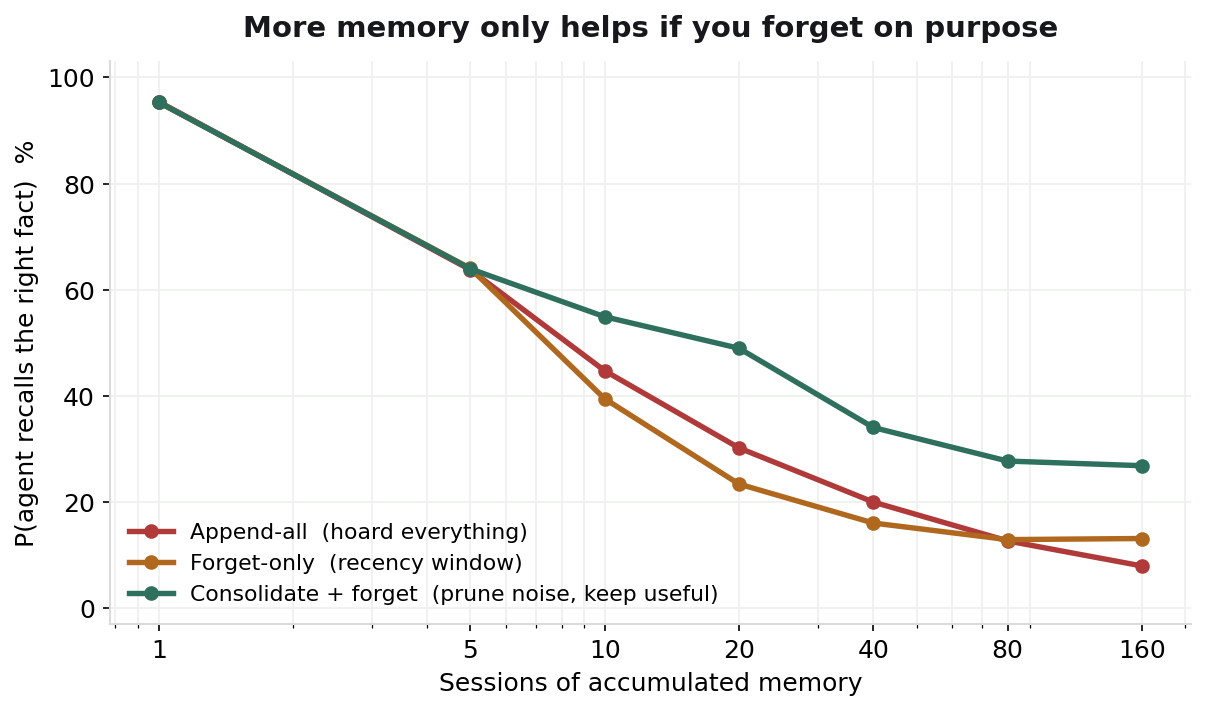
The headline isn’t subtle: the agent that remembers everything ends up remembering nothing useful. Append-all starts tied with the rest and then slides from 95% down to 8% — not because it lost the fact, but because it buried it. Forget-only does better late (a bounded store beats an infinite one) but bleeds accuracy whenever the answer is an old fact it already evicted. Only consolidate-and-forget keeps both properties — small store, durable facts — and holds roughly 3× the hoarder’s recall at 160 sessions. Same model. Same retrieval budget. The policy was the whole story.
Break my assumptions
Every slider re-runs the Monte-Carlo on the spot. Try shrinking the retrieval budget, or making facts rarer, and watch the hoarder collapse faster.
› Go deeper: exactly what the simulation does
Each session adds 6 items; a fraction are durable facts, the rest ephemeral noise. At session s we query one durable fact (recency-weighted, so old facts are asked about less but never zero). The agent retrieves the top-B items by a noisy relevance score — the target draws from N(1,σ), every other item in the store from N(0,σ) — and answers correctly only if the target is (a) still in the store and (b) ranked inside the top-B. Append keeps all items; Forget keeps the most recent cap; Consolidate prunes noise first, keeping the most-recent useful facts up to cap. The in-browser version runs ~600 trials/point for responsiveness; the Colab notebook runs 20,000 for the publication figure. Same model, byte-for-byte.
 Run the real experiment. Free CPU, ~10 seconds, pure NumPy. Hit Runtime → Run all, then change the constants and watch the curves move. The notebook is the exact code behind the figure above.
04Where forgetting still won’t save you
Memory hygiene is powerful, not magic. Three honest limits:
· Deciding what’s important is its own hard model. “Forget by value” only helps if your value estimate is decent. A bad importance score evicts the wrong things — sometimes worse than FIFO. Importance scoring is the new place the difficulty hides, not a place it disappears.
· Forgetting is irreversible — and sometimes wrong. A fact you pruned as noise may turn out to matter next week. Tiered storage (cheap cold archive you can page back in) softens this, but “what may I safely forget?” has no perfect answer, the same way it doesn’t for people.
· Consolidation can launder errors into “facts.” Summarize five turns into one canonical memory and any mistake in the summary is now load-bearing and hard to trace. Aggressive write-path compression trades retrieval clarity for a new class of silent, baked-in errors.
The takeaway
Stop measuring agent memory by how much it can hold. A memory that can’t forget isn’t long-term memory — it’s a slow, expensive way to bury the one fact you needed. The win isn’t a bigger store; it’s a smaller, sharper one: consolidate on write, forget by value, supersede on contradiction, decay the unused.
The agent that feels like it remembers you won’t be the one that kept every word. It’ll be the one that knew what to forget.
Next in this series: We Gave Agents Tools but No Undo Button — why a long agent with no rollback fails silently, and the database wisdom that fixes it.