Staff ML Engineer / Scientist · LLM & Recommendation Systems

Sugeerth Murugesan

I build, train, and evaluate LLM-powered recommendation and agentic systems at scale — and the research behind them: post-training & alignment (DPO · GRPO · RLHF · LoRA), retrieval, and evaluation. I ship runnable experiments — and report what actually moves the metric.

PhD, UC Davis · 20+ open-source AI projects · 5M+ users in production · every project below links to running code

Hiring for LLM / RecSys / agentic-AI roles? Start with the three featured builds, skim the recent writing, or just email me — I reply within a day.

About Sugeerth Murugesan

About

Portrait of Sugeerth Murugesan

Sugeerth Murugesan

Staff ML Engineer / Scientist · LLM & Recommendation Systems

I build, train, and evaluate LLM and recommendation systems — post-training and alignment, agentic pipelines, retrieval, and the training / inference infrastructure behind them. I hold a PhD in Computer Science from UC Davis and work as a Staff ML Engineer / Scientist at Intel / Intuit, shipping LLM-powered recommendation systems in production. My GitHub is a working lab of 20+ open-source AI projects — each one a runnable experiment with results.

Currently

LLM-powered recommendation systems

Building and shipping LLM-powered recommendation and agentic systems in production at Intel / Intuit — and running open experiments in post-training, evaluation, and RAG, measuring what actually moves quality and cost.

Recommendations LLMs Agentic AI Evaluation
Research & Industry
Intuit Intel Samba TV Adobe Research UC Davis UC Berkeley Lawrence Berkeley National Lab
02

AI Systems Projects

Production-shaped LLM systems — retrieval, routing, agents, observability, and inference.

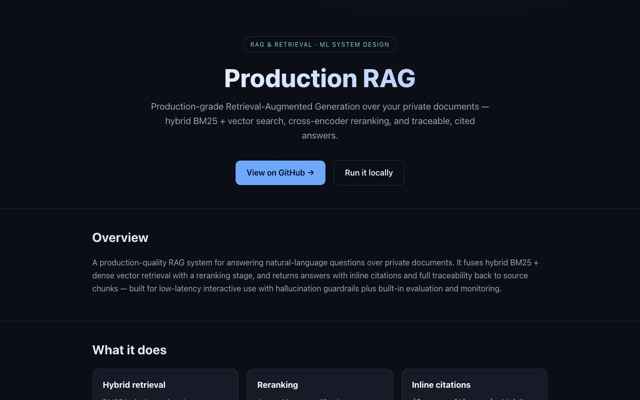
RAG Production RAG
Production-grade RAG over private documents: hybrid BM25 + dense retrieval fused via Reciprocal Rank Fusion, cross-encoder reranking, and answers with inline citations traceable to source chunks. Ships prompt-injection detection, confidence-based abstention, and a built-in evaluation suite + monitoring dashboard. FastAPI · ChromaDB · Sentence-Transformers.
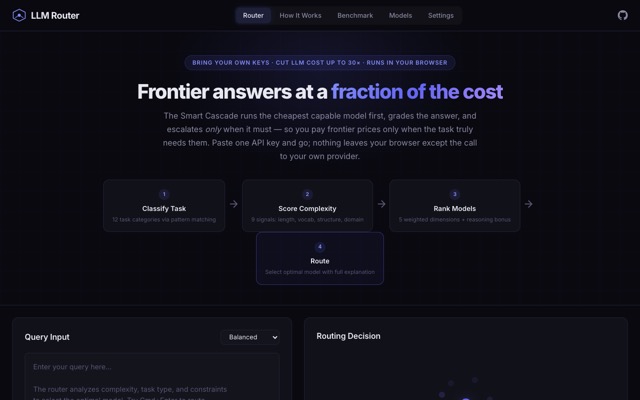
Routing LLM Router
Intelligent model routing that scores every model across task match, complexity fit, cost, speed, and context to pick the optimal LLM per query — with Balanced / Max-Quality / Max-Speed / Min-Cost modes across OpenAI and Anthropic models. Runs entirely in the browser, no backend.
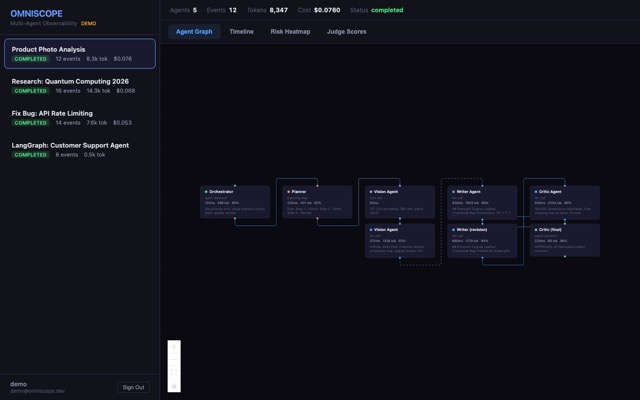
Agent Observability OMNISCOPE
A multi-agent observability platform that captures the causal DAG of every inter-agent decision (not flat logs), scores quality with a 6-judge LLM panel, predicts failures on the live execution graph, and supports time-travel debugging. Drop-in adapters for LangChain, CrewAI, AutoGen, OpenAI Agents, and Anthropic; judges and embeddings run locally on Ollama.
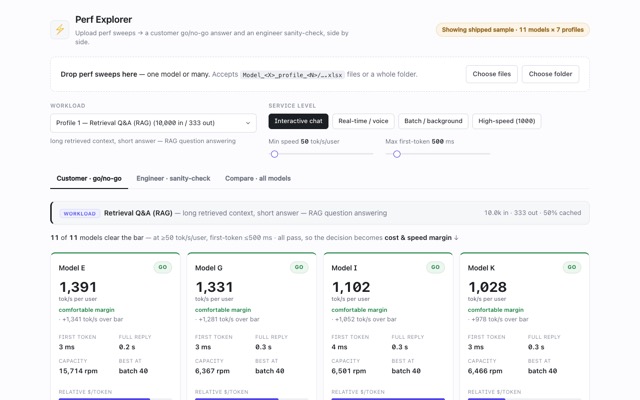
Inference Perf Explorer
An LLM-inference performance explorer: upload model perf sweeps and get a customer go / no-go answer, an engineer sanity-check, and side-by-side comparison — parsed and rendered live in the browser, no backend. React + TypeScript.
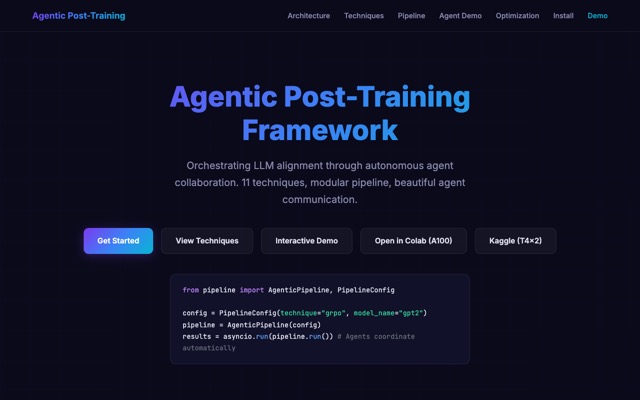
Multi-Agent Agentic Post-Training Framework
A modular framework where specialized agents coordinate an LLM post-training pipeline — technique selection → training → optimization → evaluation — communicating over a structured message bus so the whole alignment process is observable and debuggable. Apache-2.0, with a Colab + Pages demo.
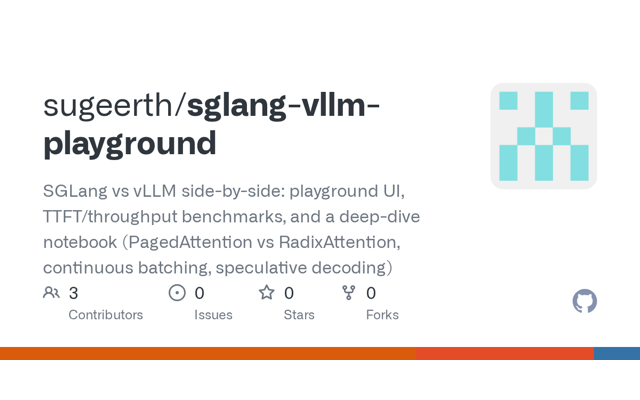
Inference SGLang vs vLLM Playground
A side-by-side LLM-serving benchmark: send the same prompt to SGLang and vLLM, compare outputs, and measure time-to-first-token, total latency, and throughput (tokens/sec) with batch benchmarks and interactive charts. FastAPI backend.
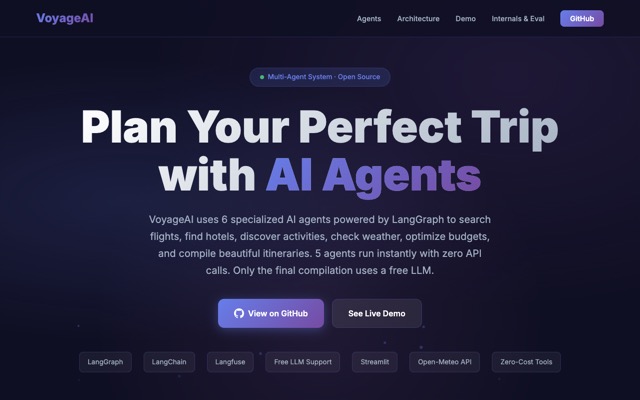
Multi-Agent VoyageAI — Multi-Agent Planner
A supervisor-worker multi-agent system built on LangGraph, LangChain, and Langfuse, where specialized agents (flights, hotels, activities, weather, budget, itinerary) collaborate to produce a plan — with full tracing/observability of the agent graph.
03

Research & Experiments

Hypothesis → experiment → measurement. Each project asks a concrete question and reports what the data actually says.

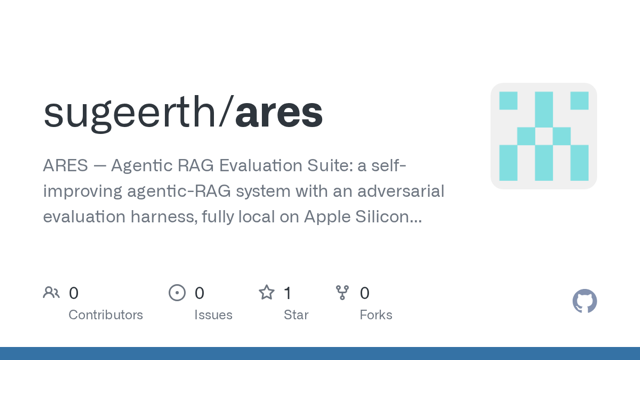
Eval Suite ARES — Agentic RAG Evaluation Suite
F1 0.378 · +28.7% 55 configs swept
Searches the design space of a retrieval-augmented agent — retrieval depth, BM25 / dense hybrid weighting, prompt style, query decomposition, self-reflection — scoring each config on multi-hop QA (HotpotQA) and reporting the quality-vs-cost Pareto frontier. Across 55 configurations, the winner reached F1 0.378 (+28.7% over baseline) at 0.12 s/question. Headline finding: chain-of-thought prompting drove the entire gain — retrieval tuning barely moved F1, and retrieval recall and answer-F1 were decoupled. Runs fully local on Apple Silicon (MPS).
Alignment DPO from Scratch
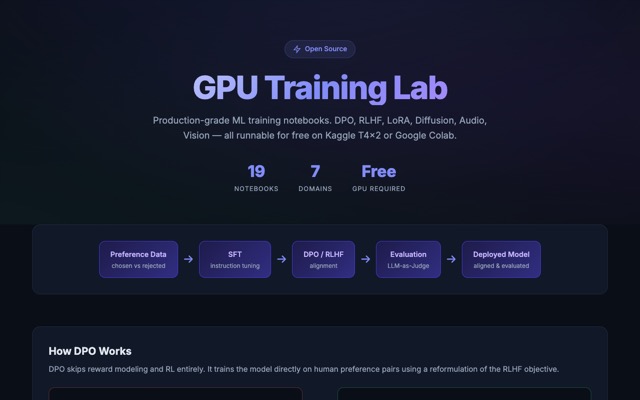
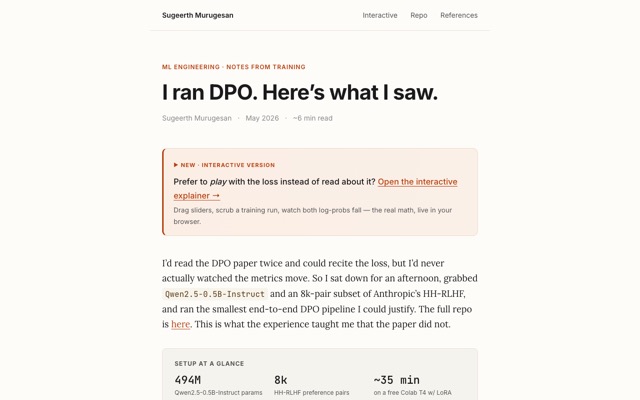
Direct Preference Optimization on Qwen2.5-0.5B + Anthropic HH-RLHF (8k preference pairs), β=0.1, LoRA — ~35 min on a free T4 — built to show what the chosen / rejected log-probs actually do during training and what β trades off. Includes a write-up: “I ran DPO. Here's what I saw.”
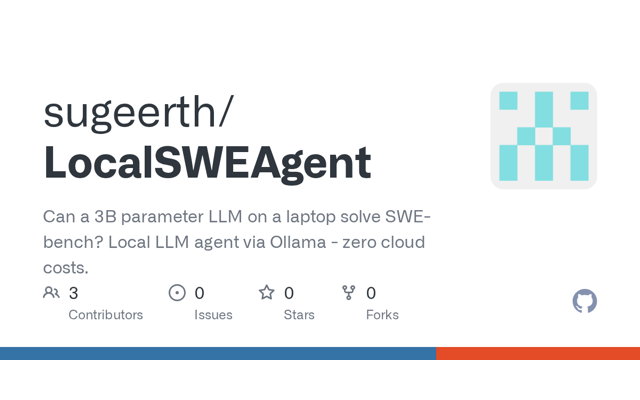
SWE-Bench LocalSWEAgent
6/7 patches $0 API cost
A lightweight SWE-bench agent asking whether a 3B model on a laptop can fix real GitHub issues. Honest result: a Qwen2.5-3B agent produced valid patches for 6/7 reachable issues at $0 API cost — but resolved 0%, consistently targeting the wrong root cause. Establishes a zero-cost baseline and pinpoints exactly where small models break down.
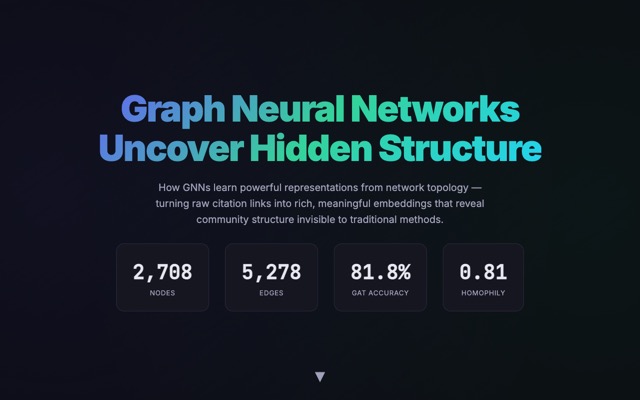
GNNs Graph Neural Networks
GAT 81.8% NMI 4.5×
Trains GCN, GAT, and GraphSAGE on the Cora citation network and shows that GNN-learned embeddings capture community structure 4.5× better than raw features (cluster NMI 0.13 → 0.59); GAT reaches 81.8% test accuracy. Interactive attention visualizations + Colab.
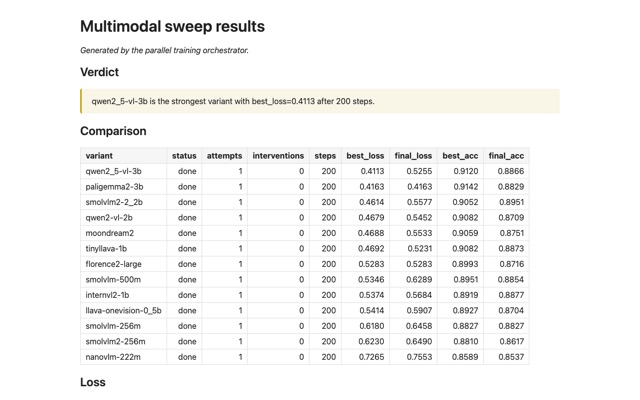
Training Orchestration Multimodal Training Sweep
A parallel multimodal-LLM training-sweep orchestrator with watchdog crash / stall recovery (halves the batch size and relaunches), SQLite-backed run + metric tracking, an auto-generated comparison dashboard, and a Claude-written verdict on the best variant — auto-published to GitHub Pages.
Distributed Training Multi-GPU Training Viz
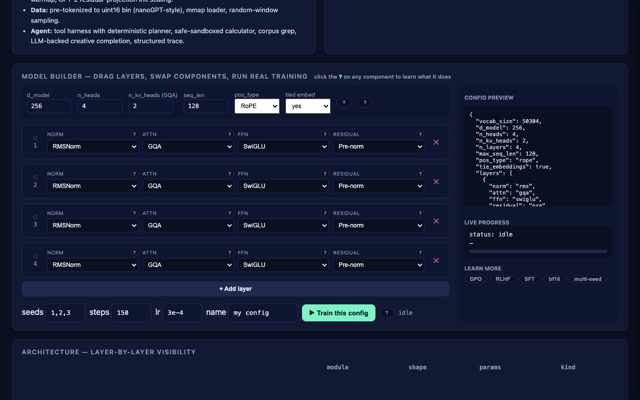
Trains the same nanoGPT four ways — single-GPU, DDP, FSDP, and DeepSpeed ZeRO-2 — streaming per-step loss, throughput, memory, and grad-norm to JSONL for side-by-side comparison, with a decision tree and documented multi-GPU gotchas. Reproducible on free Colab / Kaggle T4s.
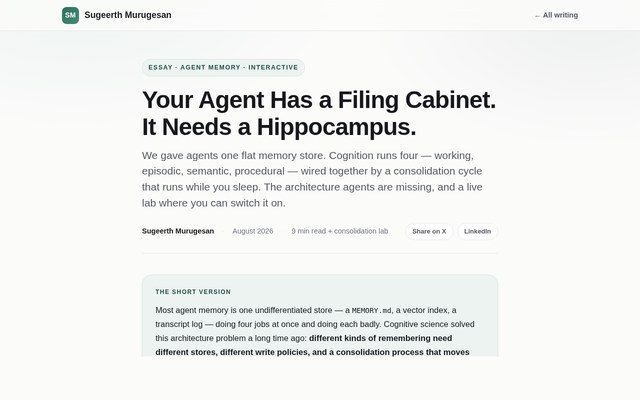
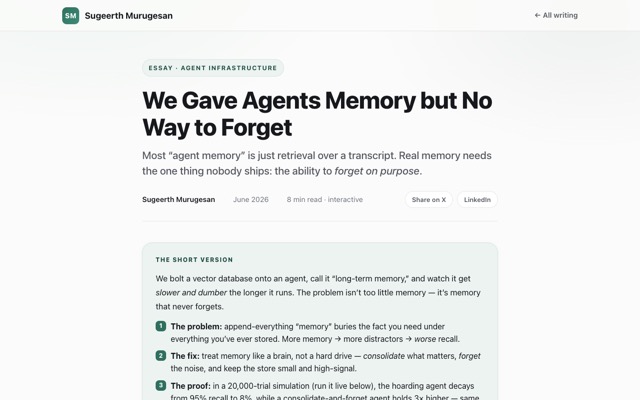
Agent Infra · Interactive We Gave Agents Memory but No Way to Forget
Most “agent memory” is just append-everything retrieval — and it makes agents worse over time. Why real memory needs forgetting, with a live in-browser simulation and a one-click Colab notebook (20,000-trial Monte-Carlo).
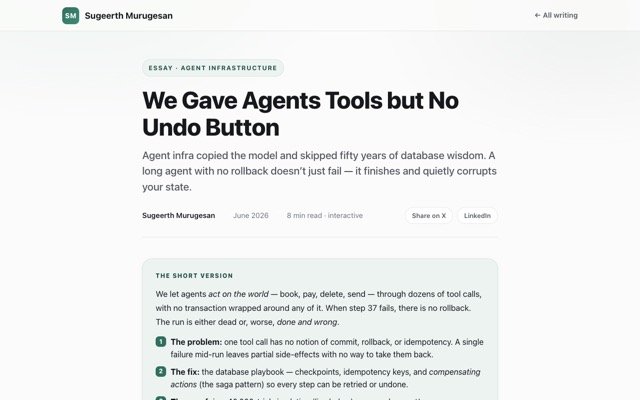
Agent Infra · Interactive We Gave Agents Tools but No Undo Button
A long agent with no rollback doesn’t just fail — it finishes and quietly corrupts your state. The database wisdom (checkpoints, idempotency, compensation) that fixes it — with a live simulation and a Colab notebook (40,000-trial Monte-Carlo).
Eval Study You’re Grading Your AI on the Wrong Test
Why a benchmark win ≠ a model that works — variance, contamination, biased LLM judges, and reliability@k — backed by a 20,000-trial simulation showing how more data on a contaminated test makes you more confidently wrong.
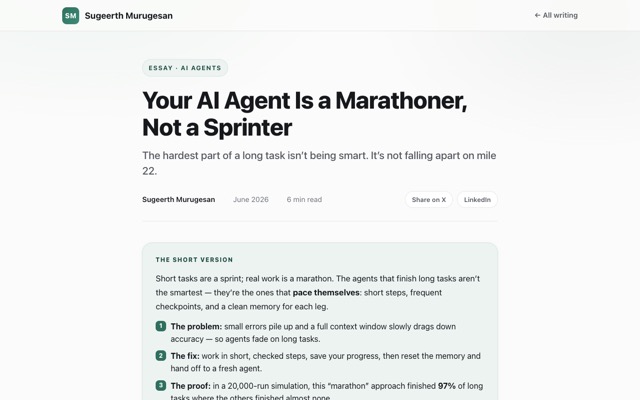
Agent Study Your AI Agent Is a Marathoner, Not a Sprinter
A field-grounded playbook for long-horizon agents — compounding error, context rot, pacing, checkpoints, context resets, and sub-agent relays — backed by a 20,000-trial simulation of how agents fail (and recover) over long runs.
04

More Projects

Earlier interactive builds and data-visualization work — plus the full portfolio archive.

Interactive Viz · Live demo LinkedIn Network Exploration
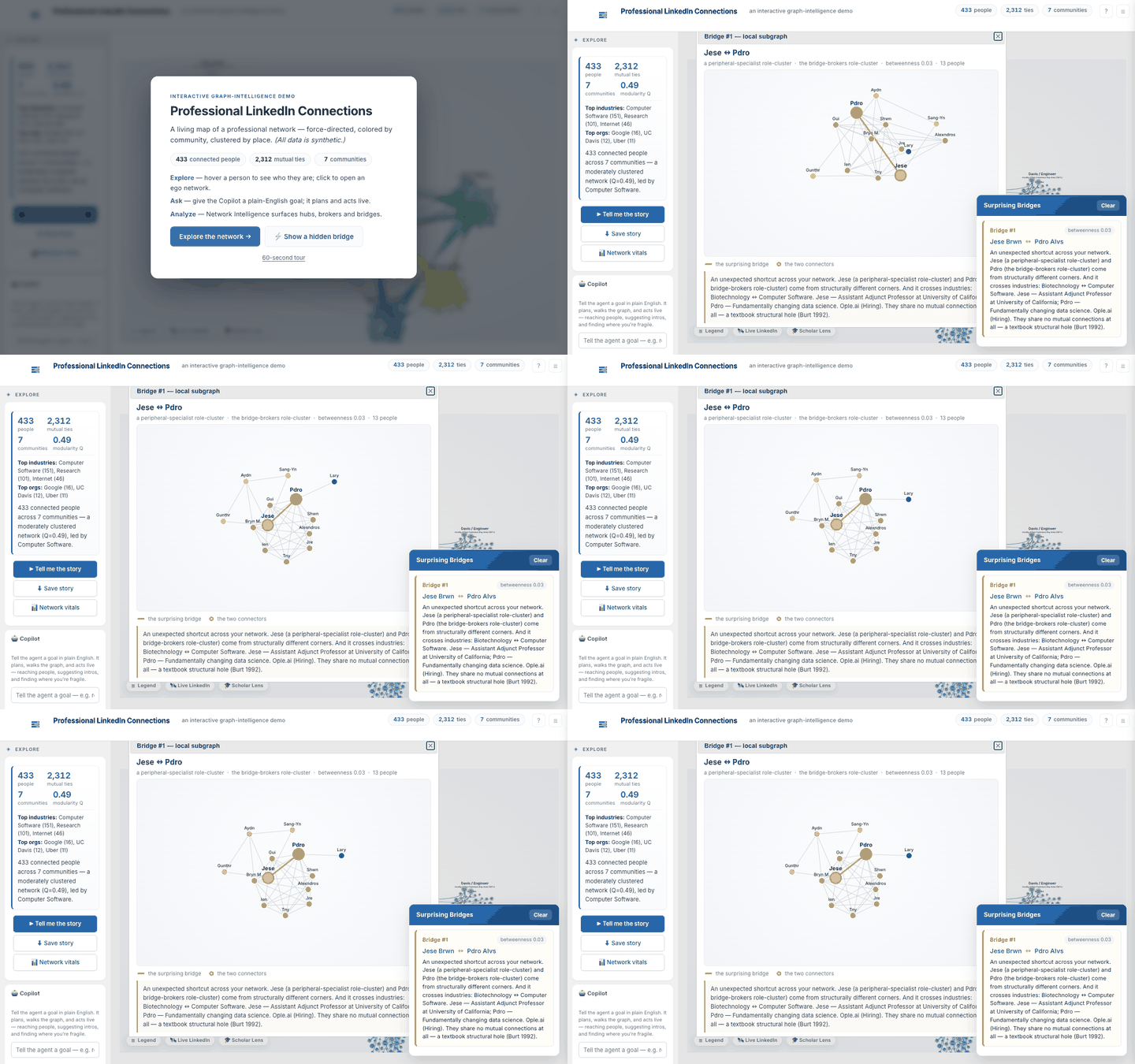
▶ animated reel Synthetic / fake data D3.js force graph
An interactive D3.js force-directed map of a professional network (~499 people, 2,312 ties) with community detection, location clustering, and betweenness-centrality highlighting, plus an unsupervised “surprise” engine for bridge connections. All data shown is synthetic / fake — no real LinkedIn connections are used.
The full archive of earlier projects, demos, and visualization work — research software, D3 / web experiments, and side builds collected in one place.
05

Open Source

Tools others can install and run — plus earlier research software licensed by UC / LBNL.

agent-trace-viz Developer Tool · v0.7.0
A pip-installable, drop-in observability tracer for AI agents: one import records the full run as a tree of spans — plans, decisions, tool calls, sub-agent invocations, memory ops, retries, and the underlying Anthropic / OpenAI calls. Structural capture, not just a timeline.
rag-optimized AI Tooling
An observable, optimized RAG pipeline with a web UI, real span tracing and guardrails, a one-click Render deploy, and a no-API-key demo mode. Includes a LoRA Lab that fine-tunes a tiny adapter in pure NumPy (hand-written gradients) live on free-tier hardware.
Brain Modulyzer Research Software · UC / LBNL licensed
A hierarchical visual exploration technique for fMRI data — the system behind an IEEE TCBB '16 paper. Licensed by the University of California through Lawrence Berkeley National Laboratory.
ECoG Cluster Flow Research Software · Best Paper ACM-BCB '16
Interactive spatio-temporal cluster analysis of electrocorticography data — Best Paper at ACM-BCB '16, extended in BMC Bioinformatics '17. Licensed by the University of California through Lawrence Berkeley National Laboratory.
06

Technical Writing

Explaining how modern AI systems behave and how ML algorithms work — the long-form work lives on Medium.

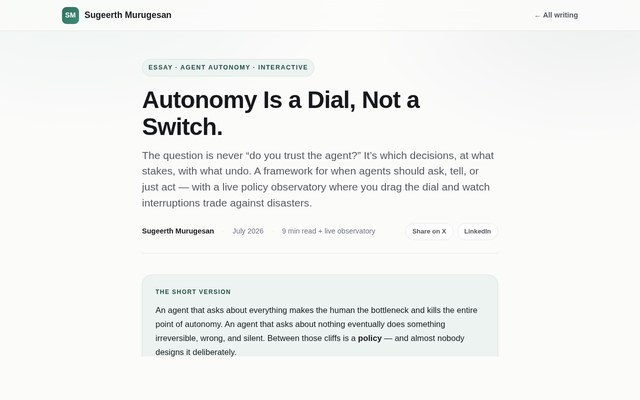
Agent Autonomy · Interactive · D3 Autonomy Is a Dial, Not a Switch.  ·  New & interactive
When should an agent ask, tell, or just act? An expected-loss framework (confidence × stakes × reversibility), a per-task-class trust ratchet, escalation mechanics that prevent rubber-stamping — and a live policy observatory: 400 streaming decisions, draggable thresholds, and a Pareto frontier showing exactly where your policy sits between interruptions and catastrophes.
Visualization × Agents · Interactive Agents Became Systems. Nobody Drew Them.  ·  New & interactive
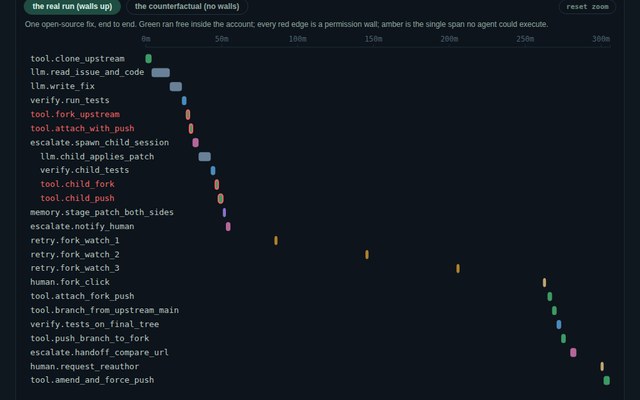
We debug distributed systems by scrolling JSONL. A five-layer framework for visualization across the agent lifecycle — trace waterfalls, behavior fingerprints, workflow flows, live architecture maps, deployment dashboards — grounded in Shneiderman / Tufte / Munzner, with a live D3 control room: plug the Planner, Memory, and Verifier in and out of a running agent system and watch the consequences flow.
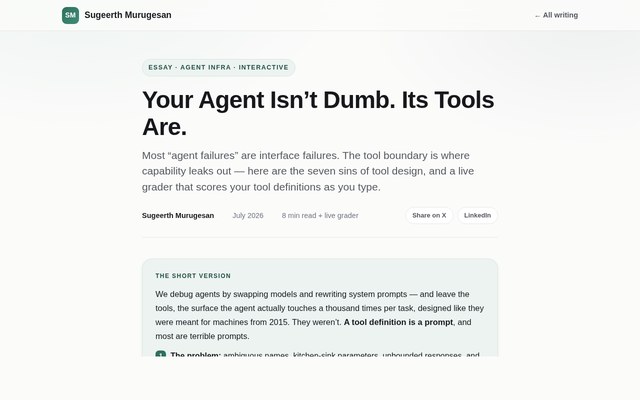
Agent Infra · Interactive Your Agent Isn’t Dumb. Its Tools Are.  ·  New & interactive
Most “agent failures” are interface failures: a tool definition is a prompt the agent re-reads at every decision point. The seven sins of tool design (ambiguous names, kitchen-sink params, unbounded responses, dead-end errors…), a per-tool eval loop — and a live grader that scores any MCP / function-calling JSON on 8 dimensions as you type.
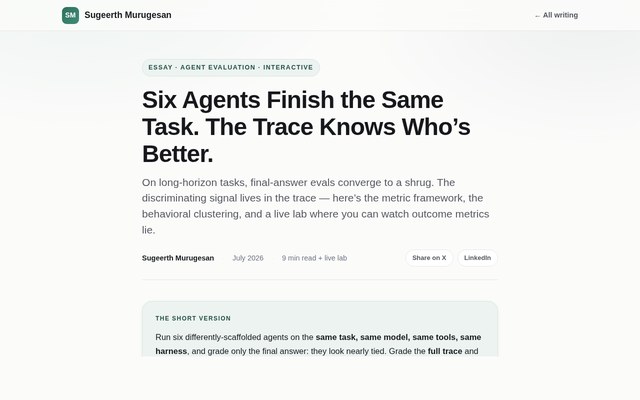
Agent Evaluation · Interactive · D3 Six Agents Finish the Same Task. The Trace Knows Who’s Better.  ·  New & interactive
Six differently-scaffolded agents, one task, same harness — an answer-only judge calls it a six-way tie while the traces blow them apart. A trace-metric framework (recall@K, progress-AUC, loop rate, verification, pass^k), behavioral clustering with kNN drift alarms, and a live D3 fingerprint lab that runs the whole experiment in your browser.
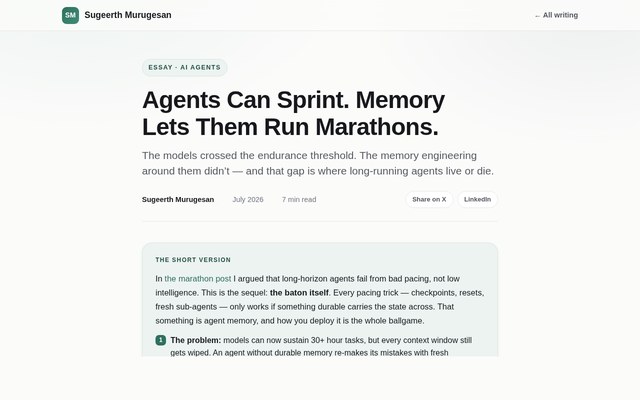
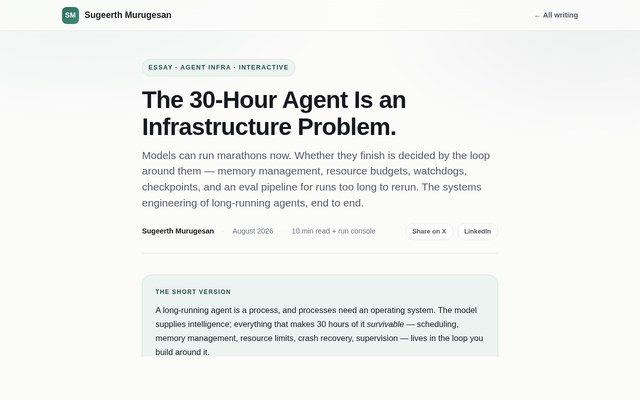
Agent Infra · Interactive Agents Can Sprint. Memory Lets Them Run Marathons.  ·  New & interactive
The sequel to the marathon post: the baton itself. Models sustain 30+ hour tasks but every context window still gets wiped — why agent memory and its deployment is the whole ballgame, via Anthropic’s long-running harness and Nous Research’s self-correcting Hermes — with a live "memory relay" simulation you can steer (failure rate, context size) and the design-review checklist.
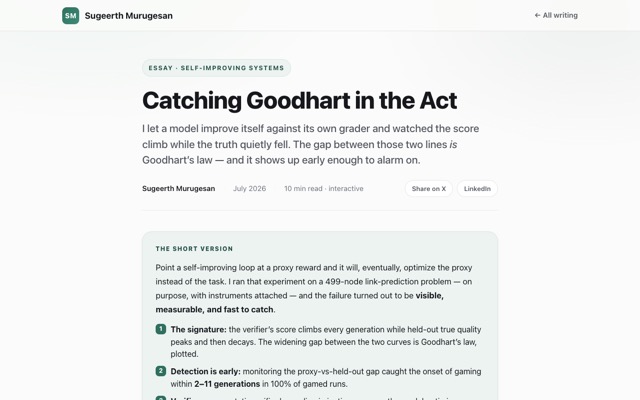
Self-Improving Systems · Essay Catching Goodhart in the Act  ·  New & interactive
I let a model improve itself against its own grader and watched the score climb while held-out truth quietly fell. Divergence-onset monitoring caught the gaming within 2–11 generations in 100% of gamed runs — with a live simulation and the "verifier half-life" playbook.
AI Agents · Report Your AI Agent Aced the Test. It Still Can’t Do the Job.  ·  New
Capability soared while 95% of enterprise pilots returned nothing. Why reliability — not intelligence — is the wall for AI agents in 2026, and the operator’s playbook for crossing it.
Multi-Agent · Report More Agents Isn’t Better: The Coordination Tax  ·  New
Two frontier labs reached opposite conclusions on multi-agent systems. The reconciliation — single strong agent by default; multi-agent only for verifiable, parallel breadth — plus the ~15× token tax and the MAST failure taxonomy.
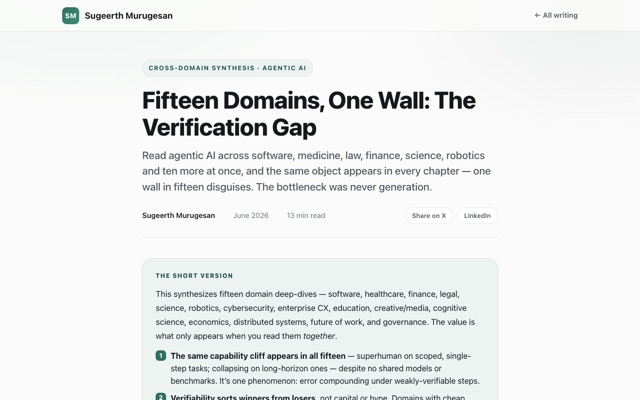
Agentic AI · Report Fifteen Domains, One Wall: The Verification Gap  ·  New
Read agentic AI across fifteen domains at once and the same wall appears in every one. Why the bottleneck was never generation — it’s verification — and where value migrates next: the “Trust Stack.”
Explainability Why Did You Rank That? Explainability for LLM-Powered Retrieve-and-Rank  ·  New
A method-by-method field guide to explaining the four-stage ranking funnel — SPLADE/ColBERT structural readouts, RankingSHAP, activation patching, faithful logit signals, counterfactual stage ablation — and the one rule underneath them all: plausible is not faithful. Fact-checked multi-agent research pass.
Retrieval / RecSys Two Towers, One Index: How Retrieval Models & ANN Search Are Co-Designed  ·  New · interactive
A source-grounded deep dive with a drag-to-explore demo: the two-tower model and approximate nearest neighbor search are one co-designed system, not two. From DSSM and the logQ correction to HNSW, IVF-PQ and ColBERT — and how the exact same machine powers recommendation feeds. Assembled by a fact-checked multi-agent research pass.
Agent Infra We Gave Agents Memory but No Way to Forget  ·  New & interactive
“Agent memory” is usually append-everything retrieval — and it makes agents worse over time. Why real memory needs forgetting, with a live in-browser simulation and a Colab notebook.
Agent Infra We Gave Agents Tools but No Undo Button  ·  New & interactive
Without rollback, long agents don’t just fail — they finish and corrupt state. The database wisdom that fixes it — checkpoints, idempotency, compensation — with a live simulation and a Colab notebook.
Evaluation You’re Grading Your AI on the Wrong Test  ·  New
A benchmark win isn’t a model that works — a playbook on eval variance, contamination, biased LLM judges, and reliability@k, backed by a 20,000-trial simulation of how grading method beats raw model quality.
Agents Your AI Agent Is a Marathoner, Not a Sprinter
Long-horizon agents fail like marathoners, not sprinters — a playbook on compounding error, context rot, pacing, checkpoints, context resets, and sub-agent relays, backed by a 20,000-trial simulation.
Earlier writing · Medium
Designing deep learning models is hypothesis-driven; interpretability is key to trustworthy models — the Achilles' heel of deep neural networks.
An attempt to clearly explain the simplest ML algorithm in Python — predicting a linear relationship between inputs X and an output Y.
Neural networks are now ubiquitous — convolutional, recurrent and beyond — with manifold applications across medicine, transportation, and visualization.
The importance of visual analytics in machine learning, as ML methods play an increasingly influential role in the world.
Transportation, brain, and social networks all rely on machinery from graph theory and data visualization.
07

AI Infrastructure & Experience

Where the models meet production — experience across industry research and the infrastructure that scales AI systems.
Experience
  • Staff ML Engineer / Scientist — Intel / Intuit
    Building and shipping LLM-powered recommendation and agentic-AI systems in production. Also DeepInsight — a real-time ML analytics engine for network understanding (C++, Python, Kubernetes, Kafka, GoLang, TensorFlow, Apache Flink, ML anomaly detection).
  • Research Engineer — Samba TV
    Co-creator of Sambavision — applied ML/CV research shipped into product.
  • Research Intern — Adobe Research
    Interpretable deep learning — DeepCompare, for comparing and debugging deep models (patent + IEEE CG&A).
  • Graduate Fellow — Lawrence Berkeley National Lab
    Computational Research Division — large-scale scientific data + ML.
Education
Infrastructure & Scale

The systems work behind the models. At Intel / Intuit I help build DeepInsight, a real-time ML analytics engine — streaming pipelines on Kafka and Apache Flink, services in C++ / GoLang / Python on Kubernetes, with ML anomaly detection. The same instinct runs through my open-source work: distributed training (DeepSpeed / FSDP / DDP), inference serving, and agent observability — infrastructure in service of shipping and scaling AI systems.

20+
Open-source AI projects
8
Peer-reviewed papers
150+
Citations
5M+
Users in production
08

Publications

Peer-reviewed research — modelling data through mathematical models and visualization, with a Best Paper award and a patent.

09

Skills

Organized for AI research engineering. Highlighted skills are where I do my deepest work.

AI & Machine Learning
LLM Post-Training (DPO / GRPO / RLHF) LoRA / QLoRA Fine-Tuning Transformers Generative AI Multimodal (VLMs) Graph Neural Networks Recommendation Systems PyTorch TensorFlow
Research & Evaluation
LLM-as-Judge Evaluation Eval Harnesses & Benchmarks Experiment Design & Ablations RAG Evaluation Quality / Cost Pareto Analysis Hyperband / HPO Reproducible Experiments
Systems & Infrastructure
Distributed Training (DeepSpeed / FSDP / DDP) Inference Serving (vLLM / SGLang) Agent Observability & Tracing Real-Time ML Pipelines ML Anomaly Detection
Programming
Python C++ GoLang TypeScript / JavaScript SQL
Cloud & GPU
GPU Training (CUDA / MPS) Colab / Kaggle AWS GitHub Actions / Pages
Cloud & GPU in service of training and serving models.
Distributed Systems
Kafka & Apache Flink (Streaming) Kubernetes Apache Beam Scalable Serving
Used to scale data and AI workloads — the plumbing behind production ML.
10

Contact

The fastest ways to reach me and see the work.

Get in touch

I'm always happy to talk about LLM post-training, agent evaluation, RAG, and the infrastructure that scales AI systems. Email is best — or browse the code on GitHub.

Open to ML & Research Engineer opportunities